Circular economy: robotics, research and experimentation for development that does not give in to pollution

Circular economy and innovation, together for gentle growth
The transition from a linear economic model to a circular economy is key to economic growth that respects material and natural resources, contributing concretely to the fight against climate change, a goal that the planet has committed to achieving by 2050. Here are some projects featured at Maker Faire Rome 2025 that are charting the course for this revolution.

credits MEHDIN3D
Recyclage plastique
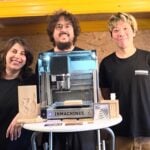
The French collective MEHDIN3D, active in the Var region, offers a concrete and replicable approach to plastic recycling. Using recycled materials and self-built machinery, they transform plastic waste into functional objects and furniture, without going through large industrial plants. Their project, recyclage plastique, is at once a production process, an educational act and a political proposal. The message is clear: with the right skills and a few tools, even waste can become a useful resource for the community. Activities often take place in public workshops, schools and social spaces. The aim is to build a culture of reuse together with the people.

credits https://www.tecnoseta.com/
Silk threads at the heart of Tecnoseta, a circular economy project
Massimo Proia, Maddalena Mariani and Antonella Della Bella decided to revive an Italian excellence that had been dormant since the 1960s: silk production. With Tecnoseta, they have created a technological and compact production model, suitable for the revival of silkworm farming and the creation of a Made in Italy silk district. The project combines robotics, archival research and direct experimentation, with the aim of restoring silk’s economic and cultural value. A rebirth that intertwines innovation and tradition, thread by thread.
New products from wood powders
Michela Reale, Tamara Pellegrini, Moreno Rotondi and Nicola Bartucca have combined scientific expertise and creativity to tackle an invisible but very real problem: the MDF and chipboard dust produced by the wood industry. With SE.LI.F, they have developed a process for directly printing these residues, without adhesives, transforming them into new products. Their approach is sustainable and replicable: it reduces waste and creates value from what previously ended up in landfill. It is a story of applied research, patents obtained and a team that sees circularity not only as an environmental strategy, but also as a form of responsibility towards the future.
credits https://mudarte.blastic.it/
Precious Plastic Genova, a community of makers who refuse to give in to pollution
Precious Plastic Genova is not just a project: it is a movement. Behind the self-built recycling machines and geodesic domes made from waste, there is a community of makers, designers and activists who have chosen not to give in to pollution. Leading them is an e-bike repairer with a background in Communication Sciences and a past as a visionary experimenter. Their challenge? To restore plastic to its rightful value. Not waste, but a resource. Not rubbish, but raw material for beautiful, useful and shared objects. In three years, between the Mudarte project and the Blastic laboratory, they have created a homemade circular economy, with IoT devices, PCBs, BMS and a lot of ingenuity. And while the world debates sustainability, they print it, melt it and transform it into something alive.
Follow us, subscribe to our newsletter: we promise to let just the right content for you to reach your inbox