Hands that move. Faces that think.

Microchip Technology is back at Maker Faire Rome
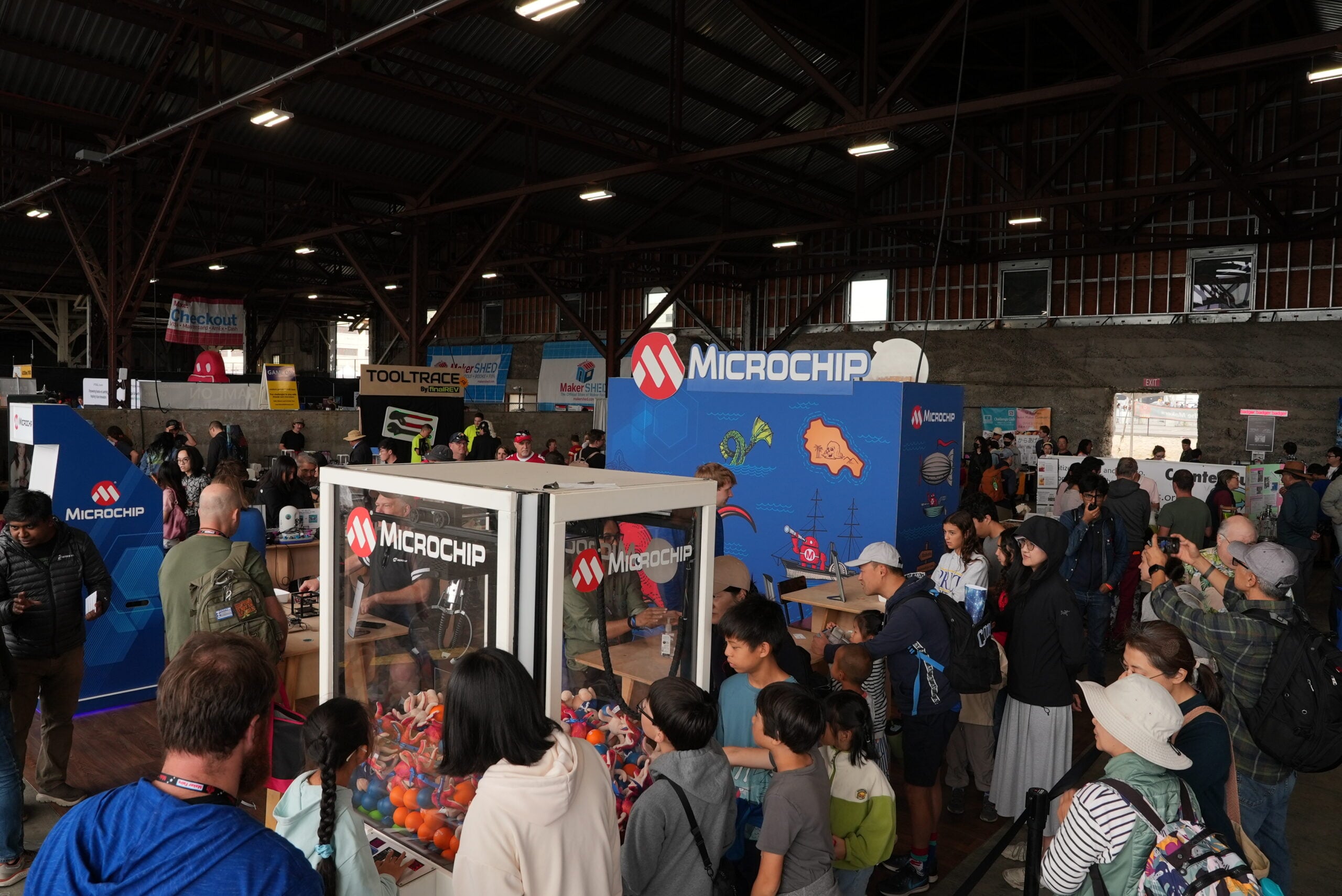
A robotic hand that responds to your gestures. A camera that not only recognizes a face but knows whether it is real. These are not concepts from a product roadmap, they are demos you can try at the Microchip Technology stand this year at Maker Faire Rome.
For more than three decades, Microchip has been building the semiconductor infrastructure that makes modern electronics work – from industrial automation to aerospace, from consumer devices to connected vehicles. Maker Faire Rome is where that infrastructure meets the people who will use it next.
The goal is not to show what technology can do. It is to put it in your hands and let you find out yourself.
Try it, don’t just watch it
The Microchip stand is built around interaction, not exhibition. This year’s demonstrations include:
- Gesture-controlled robotic hands – move your fingers, the robot follows.
- Facial recognition with liveness detection – the system identifies a face and verifies it belongs to a person present in the room, not a photograph.
Both demos are built on real embedded hardware running production-ready firmware. No simulations, no cloud dependencies: the processing happens on the device.
A market heading for $1 trillion (and a shortage of people who can work with it)
None of this exists in a vacuum. Global semiconductor sales are on track to cross $1 trillion in 2026 — a record driven by AI infrastructure, automotive electrification and industrial automation. The microcontroller market alone, the segment most relevant to embedded development and maker education, is growing at 12% annually and is expected to approach $50 billion by 2030.
The constraint is not hardware. It is people. The embedded engineering talent gap is one of the most consistently cited challenges across the industrial, automotive and defense sectors. Companies build chips. Finding engineers who know how to use them is a different problem entirely.
This is the less obvious reason why Microchip shows up at Maker Faire. The gesture-controlled robot and the facial recognition demo are impressive. But the longer game is what happens when a fifteen-year-old touches that hardware for the first time and decides they want to understand how it works.
A ruler that teaches you electronics
Among the tools on show is the Curiosity PyKit Explorer – a CircuitPython development kit that looks, at first glance, like a standard 12-inch ruler. Look closer and you find a fully equipped embedded platform: color display, motion sensor, Bluetooth, audio output, CAN bus, MicroSD slot and NeoPixels, all connected without soldering.
The idea addresses a real problem: most educational kits end up in a drawer after the first project. PyKit Explorer is designed to stay on the desk because the projects keep getting more interesting.
The workshop progression goes from blinking an LED to writing complete video games -Snake, Donkey Kong, Super Mario Bros – controlled by tilting the board. Along the way, students work with real embedded concepts: GPIO, communication protocols (UART, SPI, I²C), state machines, event-driven design, concurrent tasks.
The language is CircuitPython, an implementation of Python 3 optimized for microcontrollers. Since Python is already taught in most schools and universities, the barrier to entry is low. Connect the board, edit the code, see the result: no compilation, no complex setup needed.
From LED blink to full game development: the same board, a growing set of skills.
The people behind the workshops
The workshops at Maker Faire Rome are run by the Microchip Ambassadors – employees who work with schools, universities and makerspaces throughout the year. The format is flexible: content adapts to the audience, sessions can be split across multiple visits, and the project library keeps expanding so returning students always find something new.
This is not a sponsored education program with a logo on a banner; it’s engineers who choose to spend time with students because they think it matters. Makers with a passion for building and constantly inventing new things. Are you part of the community? Watch the video below.
New silicon for serious applications
Visitors who want to go deeper can speak with the Microchip technical team about the PIC32CM PL10 family – 32-bit microcontrollers announced in January 2026 and designed for high-volume applications where efficiency and reliability are non-negotiable: industrial automation, smart buildings, home appliances, power tools, sensor-based systems.
Key characteristics: 1.8V to 5.5V operation, integrated capacitive touch support, strong EMI noise immunity and a software ecosystem that now includes MPLAB AI Coding Assistant for accelerating development workflows.
The PL10 family is part of a broader roadmap of new microcontrollers Microchip is releasing across 2026 – evidence of a company that is not managing a legacy portfolio but actively expanding it.
Find Microchip at Maker Faire Rome!
Whether you are a student encountering embedded electronics for the first time, a maker looking for better hardware, or an engineer exploring what is possible with the latest MCUs, the Microchip stand is worth your time.
Come with questions, leave with answers – and, hopefully, with the urge to build something.
Follow us, subscribe to our newsletter: we promise to let just the right content for you to reach your inbox